
Shopify vs WooCommerce in 2026: Which Is Right for Your Store?
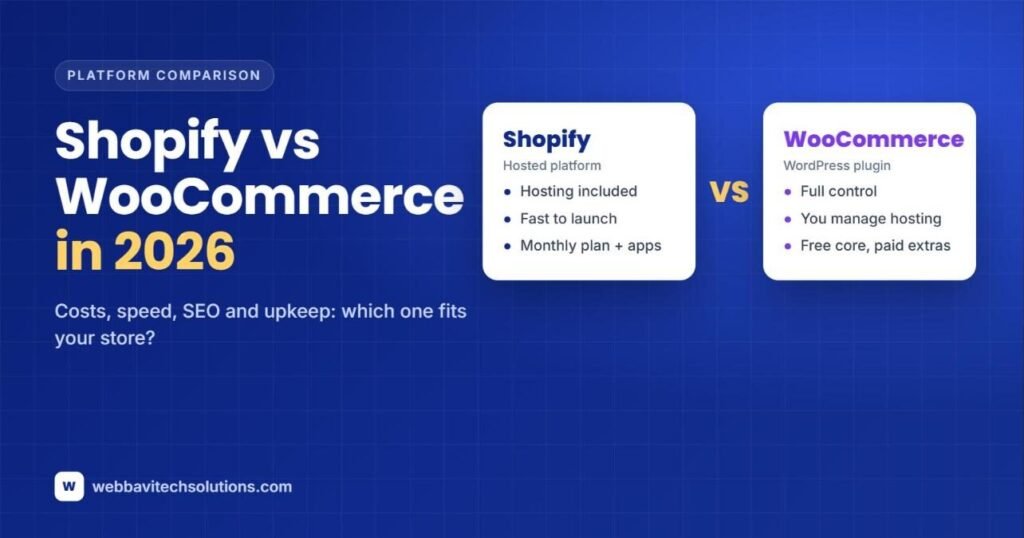
We build stores on both Shopify and WooCommerce, so we get asked this question all the time. The honest answer: both are excellent, but they suit different businesses. Here is how they compare in 2026, and how to choose.
The short answer
- Choose Shopify if you want to focus on selling, not on servers, updates and security. It’s the best fit for most growing product brands.
- Choose WooCommerce if your website is content-heavy, you already run WordPress, or you need deep custom functionality and full control over your code and hosting.
1. Cost
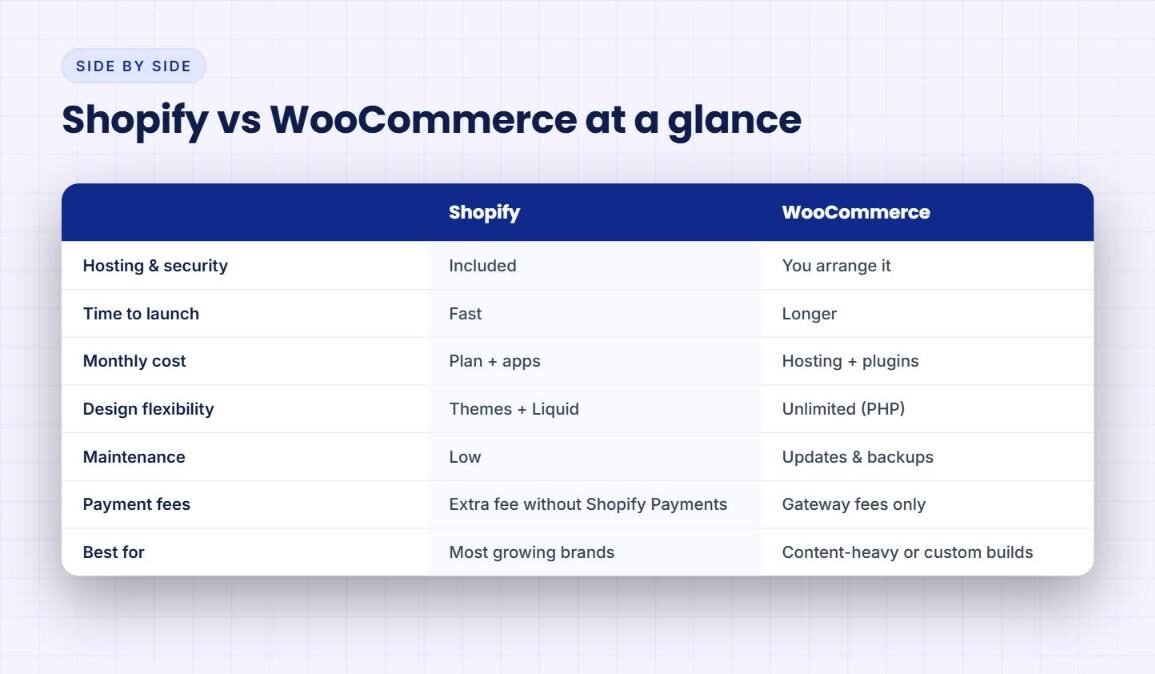
Shopify is a monthly subscription. Its standard plans start from around $39 a month when billed monthly, with a discount for annual billing (always check Shopify’s pricing page for current rates in your country). Most stores also pay for a few apps and a premium theme.
WooCommerce itself is free, but you pay for hosting, a theme, premium plugins, and someone to keep everything updated and secure. For a small store this can be cheaper than Shopify; for a busy store, good hosting and maintenance add up.
Payment fees: on Shopify, using an outside payment provider instead of Shopify Payments adds an extra Shopify transaction fee of 0.2–2% depending on your plan. WooCommerce has no platform fee; you only pay your payment provider.
2. Ease of use and maintenance
Shopify handles hosting, security, backups and updates for you. WooCommerce gives you full control, which also means you (or your developer) are responsible for plugin and WordPress updates, backups and security. If nobody looks after it, problems build up quietly.
3. Design and flexibility
Shopify themes are customised with Liquid and Online Store 2.0 sections, and almost any design can be built from a Figma file. WooCommerce runs on WordPress and PHP, so practically anything is possible, including complex custom features, membership sites and content-rich designs.
4. Speed
A well-built store on either platform can be fast. Shopify gives you fast hosting by default, so speed problems usually come from heavy apps and themes. On WooCommerce, speed depends heavily on your hosting, caching setup and the number of plugins.
5. SEO
Both platforms rank well when set up properly. WordPress has the edge for content-heavy sites and blogging, while Shopify’s fixed URL structure (/products/, /collections/) is simple but less flexible. In practice, your content, site speed and links matter far more than the platform.
6. Scaling
Shopify scales smoothly from a first sale to very high volumes, with Shopify Plus for larger brands. WooCommerce can also scale, but you will need stronger hosting and more technical care as traffic grows.
Thinking of switching?
If you are on WooCommerce and spending more time fixing your site than selling, moving to Shopify is often worth it. Read our WordPress to Shopify migration guide to see how it works without losing your SEO. If you are happy on WordPress, a speed and SEO tune-up may be all you need.
Not sure which platform is right for you?
Tell us about your products, budget and plans. We build on both Shopify and WooCommerce, so we will give you an honest recommendation, free.
